
STEAM Powered had its 6th birthday a couple of weeks ago. It’s been an absolute ride. End-to-end, aside from the theme song (”Gypsy Jazz in Paris 1935” by Brett Van Donsel), this show is entirely my own work — the branding, the website, the guest research, bookings, recording, editing, and the promotion. I’ve probably missed a few other jobs. And I couldn’t have done it without the 85+ guests who have so generously shared their stories.
As you might be able to tell, I have a vested interest in wanting to get the stories of my guests’ journeys and work out into the world to share with people who want to learn more, and who may be inspired by them.
The promotion treadmill
Of the different hats an independent podcaster has to wear, most of them, once you’ve done it a few times, get pretty comfy. You get into the groove, and even if you tweak your workflows from time to time, it doesn’t take long to settle back into the rhythm.
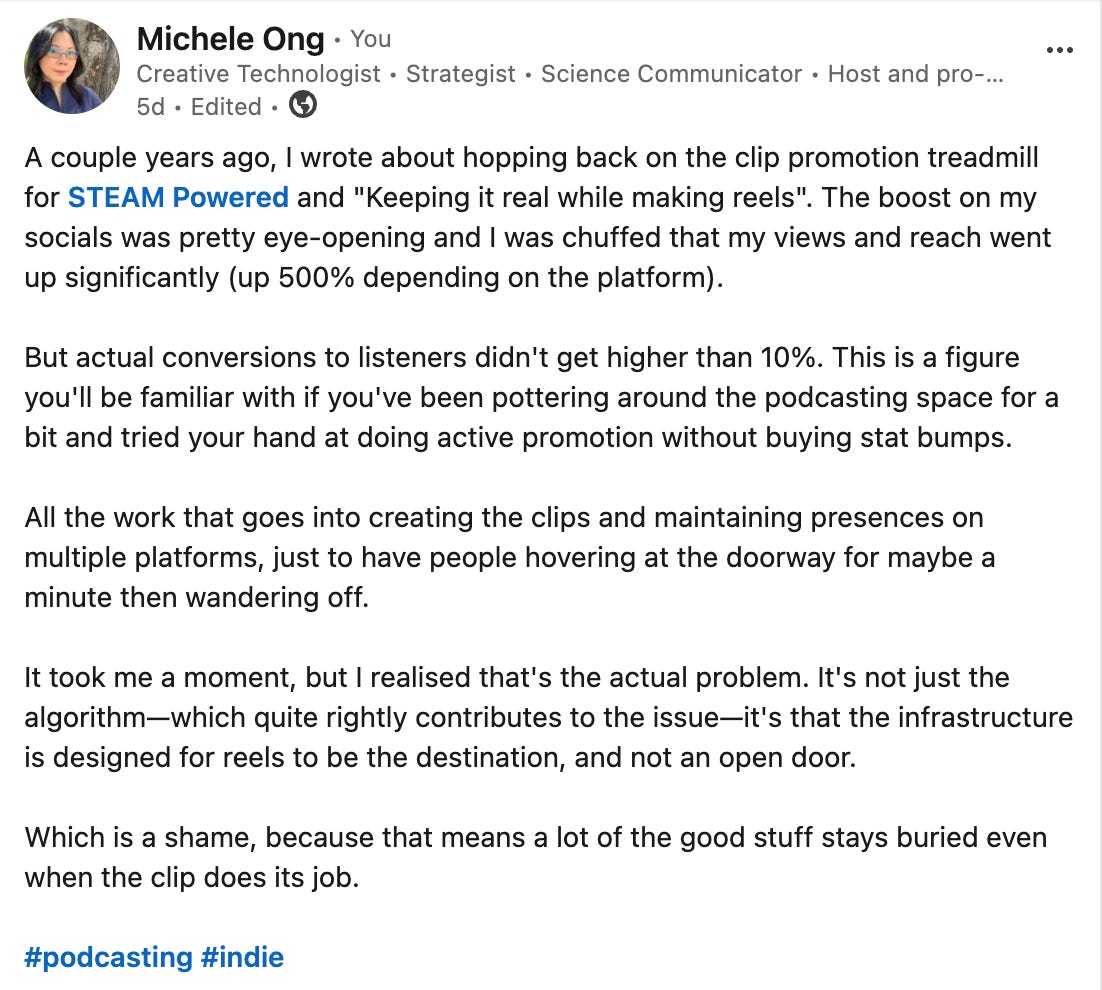
The one hat that always feels a bit awkward for me is promotion. I can’t quite get it to sit comfortably because things keep changing depending on the platform, the trends, the phase of the moon. Keeping it real while making reels was just one of the times in my many iterations of how I approached promotion where I thought I was at a turning point. I was seeing actual immediate results. Just not where I wanted them.
I wrote about this last week on LinkedIn:
Built on borrowed ground
The promotion treadmill was one problem. Running alongside it, for a while at least, was something that felt like a solution to a different one.
One of the other turning points I thought I had was a short-lived platform called Vurbl. They were a podcast listening platform that was promoting itself as podcasting’s answer to YouTube. They synced podcasts, but creators could claim their show as ‘stations’ and augment it with supplemental audio, including creating playlists of clips from any podcast content to enrich the value of their niche. This playlist feature was particularly fun with the ability to record separate audio because you could create host-led narratives where you “script around the tape” of the playlist.
They did a massive push inviting podcasters to become genre ambassadors (I was the Science ambassador). We weren’t just users, we were curators, building playlists of content in our space on themes of our choosing, that would in turn be promoted and signal boost our podcasts. It was by definition working for exposure, but the clipping and playlist functionality, on top of the gem that was the ability to create host-led narratives without having to cut them from scratch as additional episodic content was valuable, at least it was to me.
Then in early-2022, Vurbl liaisons stopped responding to ambassadors. Completely ghosted. No public announcements, no internal communications, just silence. We’d spent months helping them to build community, and weren’t even worth a goodbye. The platform was seemingly abandoned and over the next few months I’d see it degrade as their infrastructure went offline bit by bit.
On top of that, there wasn’t a way to export what we’d created. And even if we could, none of that data would be reusable unless we built infrastructure around it.
In 2024, Chartable was sunset as well after their acquisition by Spotify. At least we got an email about this one.
Things are started up as creator-first infrastructure to help us build and grow, but as with all consolidations, the users end up wearing the fallout. It’s a pattern, and I’ve stopped being surprised by it.
The synthesis
The main frustration I’ve personally experienced when it comes to these tools is that it really is all built on borrowed ground. The investment we make is only as good as the business’s ability to stay afloat, or the intent of the organisation acquiring it. Every time a merger is announced for a service I happen to be using, in podcasting or otherwise, I sigh. Then immediately check for what the export format looks like, and who the competitors are with comparable features so that I know my exit strategy if I need one in the next 6-18 months.
Vurbl stung the most though because of the potential it had, and yes, because of the time I invested. But mainly the clipping and playlist functionality because it was so useful, and all the listens went back to the hosting platform. I loved that it was truly in the spirit and letter of being able to meaningfully repurpose content without splitting the source and that we could share and embed it as we liked so that people who didn’t use Vurbl could also benefit from our curation.
So I built it with Podbite. Not to recreate what was lost, but because those things should exist independently of any single platform’s survival. I also built it with data portability in mind, because your data is yours to take with you. I didn’t build the host-led narrative part though, I had to let that go, sorry.
One note to add, Spotify launched a listener clipping tool last week not long after my first announcement. So thanks for the validation! Because clip sharing is and should be a mainstream expectation, which is good for creators and good for listeners.
While you might consider Podbite ‘yet another platform’, think of it more as a value-add layer augmenting your existing infrastructure. It doesn’t matter which host you use, or if you migrate as we sometimes do, the data will still track back wherever you land.
Podbite is what I wished existed. I built it for me first — because I’m still the independent podcaster who wants her listens to go back to her host and her best moments to travel further. Data portability isn’t an afterthought here; it’s in the foundation, because I know what it feels like when it isn’t. Your work is yours to take with you.
So if you’re interested in seeing what that looks like, the waitlist is open.
Stay curious,
— Michele
Photo by Merrilee Schultz on Unsplash